
What Happens Without Cyber Security Managed Service Providers? 9 Common Mistakes SMBs Make in 2026
What Happens Without Cyber Security Managed Service Providers? 9 Common Mistakes SMBs Make in 2026
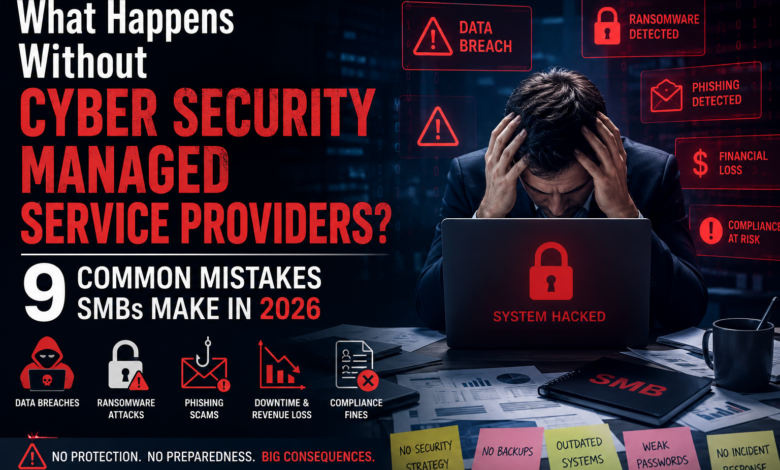
Running a small- or medium-sized business without the benefit of a cybersecurity managed service provider is like climbing a mountain without a guide. It can all go terribly wrong the moment you let your guard down. Most small and medium-sized business (SMB) owners correctly realize. They simply having a firewall, an anti-virus subscription, and trusting in their common sense is not going to be sufficient to protect their data.
Attackers know this, which is why they specifically target smaller companies. As larger organizations better allocate their resources to cybersecurity. While the costs and damage of an attack would be significant for any business. The blow to an SMB is often significantly more severe in the long term.
Without a managed partner constantly on guard for threats 24/7, vulnerabilities creep in at all times, software is not upgraded, threats go unnoticed, and much more. The following are 9 of the most common mistakes that business owners make when attempting to secure their data without professional help:
Security Is a One-Time Installation
Many businesses fall into the trap of thinking that security is a one-time investment and that it is sufficient to have some tools in place for monitoring and protecting networks and systems. Meanwhile, attackers constantly probe for weaknesses that can take advantage of even minor misconfigurations that may have been present weeks or months earlier.
Software Is Not Patched On a Regular Schedule and Is Left Outdated
A known vulnerability in software that is not patched on a regular schedule is an open invitation to attackers. Most managed service providers will have an established schedule for patching and hardening systems as needed. However, for businesses attempting to handle their cybersecurity internally without a managed service partner, this step may fall through the cracks, either for lack of a knowledgeable team or simply because it is a lower priority than other business operations. In many cases, this single oversight is all it takes for an attacker to gain unauthorized access to systems and data.
Staff Training and Awareness Is Not Prioritized
Most businesses do not consider the risk that human error poses to their overall security posture. When attempting to handle cybersecurity internally. Unless staff members are trained and kept constantly aware. The latest threats and attack vectors. They are much more likely to be the weak link in the security chain. Attackers constantly use social engineering to convince potential victims. To install malicious software or reveal sensitive information that should otherwise be protected. A good cybersecurity managed service provider will typically address this issue by including training and awareness. As part of their regular services, which most businesses would not consider when handling security internally.
Proactive Security Measures Are Not Taken
Many businesses only start to think about cybersecurity when something has already gone wrong. This results in reactive measures being taken after an incident has occurred. Rather than taking action to prevent such an incident in the first place. Without proactive security monitoring, threats can exist within a network undetected. For long periods of time, allowing attackers to gain access to more systems and data over time. Potentially doing far more damage by the time an incident is detected.
An Incident Response Plan Is Not Created and Practiced
When a security incident does occur, businesses typically do not have a clearly defined course of action. To resolve the situation as quickly as possible. Without a plan in place, time is wasted trying to determine. What to do in the aftermath of an attack, which can allow attackers to continue doing further damage or steal more data. A managed security service provider will have an established incident response plan. All parties can follow, minimizing the costs and damage of an attack.
Compliance With Industry Regulations and Standards Is Not Followed or Documented
Depending on the specific industry vertical and the data that a given business handles, there are often strict regulatory requirements that must be followed. For example, organizations handling any form of payment data must adhere to the Payment Card Industry Data Security Standard (PCI DSS). Failure to comply can lead to a variety of issues, including hefty fines and lawsuits. When it comes to compliance, most businesses simply do not understand what they are required to do or how they should keep records demonstrating that they are meeting the relevant requirements. Cybersecurity is an essential aspect of compliance, especially for industries that handle sensitive data. Businesses that attempt to handle cybersecurity internally are much more likely to incur additional costs in the long run due to penalties or data breaches that could have been avoided with a compliant security strategy.
Backup and Disaster Recovery Plans Are Not Established or Tested Often Enough
Ransomware is a very serious threat to all organizations that is especially dangerous to SMBs. They do not have proper backup and disaster recovery plans in place. The reason why ransomware specifically targets businesses without proper backup. That those organizations do not have the capacity to recover their data easily. Without regular testing of disaster recovery procedures, any ransomware attack can potentially lead to the systems of a business being encrypted. Days or weeks at a time, incurring additional costs on the organization.
Networks Are Not Secured, and Access Is Not Limited
Most small and medium-sized businesses operate using relatively flat networks wherein all users and systems have access to everything. This means that a single system compromise can lead to attackers freely accessing the rest of the network and systems behind that network. Businesses attempting to handle cybersecurity internally typically do not secure their networks to reduce the potential attack surface. Limiting access to only what a given system or user requires to perform its function.
The Needs of the Business Are Too Great to Be Handled Internally by a Smaller In-House Team
Perhaps the single largest reason why businesses fail when it comes to cybersecurity is the incorrect perception. A small in-house team can handle the same responsibilities as a dedicated, well-trained, and highly skilled cybersecurity managed service provider. In reality, many SMBs do not have the resources to invest in such a team. It is much more cost-effective to simply hire an outside agency. The appropriate experience to secure the business rather than attempt to train and maintain an in-house presence. There is also limited capacity for a small in-house team to respond to threats in the same manner as an external agency with dedicated resources for cybersecurity monitoring and incident response.
Conclusion
Small and medium-sized businesses are especially vulnerable to cyber-attacks. Whether directly or indirectly, and there is often little that a business can do to respond to threats without the dedicated expertise of a managed service provider. Additionally, businesses must also consider the costs of implementing in-house teams or services that are comparable to managed service providers.


