The PHP Security Crisis Just Exposed WordPress’s Biggest Problem. Is It Finally Time to Move On?
Two critical vulnerabilities have sent shockwaves across the internet, putting millions of websites at risk. WordPress is once again in the spotlight. But perhaps the bigger question is why businesses are still relying on website technology that requires so much maintenance just to stay secure.
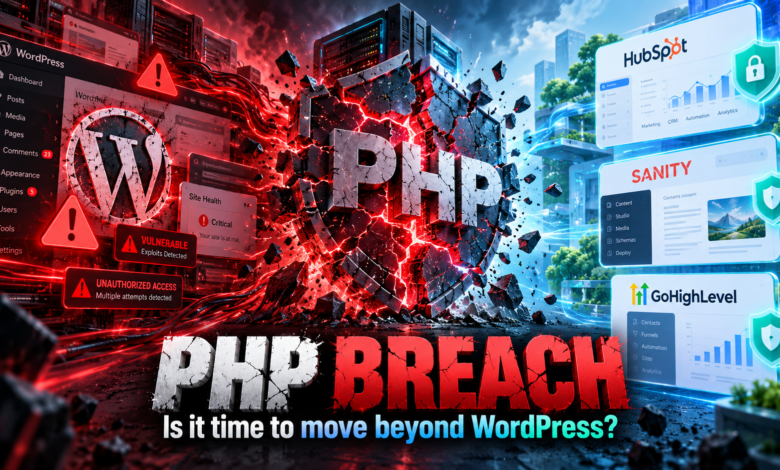
On October 21, 2026, the internet received a rather unpleasant reminder of just how fragile its infrastructure can be.
Two critical security vulnerabilities were disclosed in PHP, the programming language powering a huge portion of the world’s websites.
Both vulnerabilities received a severity score of 9.2 out of 10.
That’s not a minor bug.
We’re talking about security flaws that could allow hackers to execute malicious code on vulnerable servers remotely, potentially without needing a username or password.
Government agencies, cybersecurity organisations, and hosting providers rushed to respond. Some websites were temporarily taken offline, while emergency security patches were rolled out worldwide.
And sitting right in the middle of the drama?
WordPress.
The world’s most popular content management system (CMS), used by everyone from small businesses to major corporations.
To be clear, this wasn’t a confirmed mass breach of WordPress itself. The vulnerabilities affected PHP, meaning other PHP-based platforms were exposed too.
But the incident raises an uncomfortable question.
In 2026, should businesses really still be building their websites on technology that can become vulnerable overnight because of a problem buried deep inside its programming language?
What Actually Happened? The PHP2Shell Vulnerabilities Explained
The two vulnerabilities, identified as CVE-2026-109618 and CVE-2026-109619, have collectively been nicknamed PHP2Shell.
Both involve problems in PHP’s internal memory handling.
Without getting too technical, successful exploitation can potentially allow an attacker to run their own code on a vulnerable server.
Imagine someone gaining access to the computer running your business website without ever logging into WordPress.
Depending on the environment and the attack, that could mean accessing sensitive information, modifying website files, installing malware, or compromising connected systems.
That’s considerably more dangerous than someone simply defacing your homepage.
On October 21, the PHP development team released emergency security updates, including versions 8.2.35, 8.3.36, 8.4.27, and 8.5.12.
Security researchers and infrastructure providers also reported emerging exploitation attempts.
Meanwhile, websites belonging to government organisations and other institutions were temporarily taken offline as a precaution.
The important distinction is that being vulnerable doesn’t automatically mean a website has been hacked.
However, the potential consequences were serious enough for cybersecurity agencies to recommend immediate patching, with temporary shutdowns considered where updating wasn’t possible.
And for businesses running outdated PHP installations, particularly unsupported versions, that’s a significant problem.
Why WordPress Is Such an Attractive Target
Let’s be fair.
WordPress isn’t inherently terrible software.
It’s popular for good reasons. It’s flexible, familiar, relatively inexpensive to get started with, and supported by an enormous developer community.
But its greatest strength might also be its biggest weakness.
WordPress is everywhere.
That makes it incredibly attractive to cybercriminals.
Why spend time developing an attack against some obscure CMS when you can target technology used by an enormous portion of the internet?
Attackers can scan thousands of websites automatically, searching for vulnerable configurations and outdated software.
And WordPress offers plenty of potential entry points.
Consider a typical small-business WordPress website.
You’ve got the core WordPress installation, a theme, a page builder, an SEO plugin, a contact form plugin, perhaps WooCommerce, and several other plugins installed over the years.
Every additional component introduces another dependency to manage.
According to Patchstack’s State of WordPress Security in 2026 report, researchers identified more than 11,000 new vulnerabilities across the WordPress ecosystem in 2025.
Approximately 91% were found in plugins.
That doesn’t mean every plugin is unsafe, but it demonstrates just how much security responsibility is spread across third-party developers.
One neglected component can become a problem for the entire website.
And yesterday’s PHP incident introduced another uncomfortable reality.
Even if your WordPress installation and plugins were completely updated, your website could still be exposed through an outdated PHP runtime.
Simply clicking “Update WordPress” wouldn’t fix it.
The Hidden Cost of a “Free” Website
Here’s something businesses rarely consider when choosing WordPress.
The software might be free.
Keeping it secure isn’t.
Someone needs to monitor updates, maintain backups, test plugin compatibility, check server configurations, manage hosting, and respond to security incidents.
For a business with an experienced developer or a managed hosting provider, that’s manageable.
But what about a small business whose website was built by a freelancer three years ago?
- Who is checking its PHP version?
- Who is reviewing whether its plugins are still supported?
- Who is responsible when an emergency security patch needs to be installed immediately?
Often, the answer is nobody.
That’s the real problem.
Not that WordPress can’t be secured, but that maintaining its security can require technical attention many businesses simply aren’t equipped to provide.
And perhaps it’s time we questioned whether that responsibility should sit with business owners in the first place.
So, What Are the Modern Alternatives?
Fortunately, WordPress is no longer the only serious option.
Modern website and CMS platforms increasingly offer managed infrastructure, fewer self-maintained components, and better integration with business operations.
Here are three worth considering.
1. HubSpot Content Hub — Best for Established Businesses and Marketing Teams
<text>HubSpot</text> has evolved well beyond a simple CRM and marketing automation platform.
Its <text>Content Hub</text> provides website management, landing pages, blogging, analytics, personalisation, and integrations with its broader marketing and sales ecosystem.
One significant advantage is managed hosting.
Instead of maintaining a PHP server and worrying about individual plugin compatibility, businesses can use HubSpot’s hosted website infrastructure.
HubSpot also offers managed SSL and built-in content management tools.
But the biggest selling point isn’t just security.
It’s connecting your website directly with your CRM.
Imagine knowing which pages a potential customer visited, what content they downloaded, and which marketing campaigns influenced their enquiry.
That’s where an integrated platform becomes particularly powerful.
The downside?
HubSpot can become expensive, particularly when you need more advanced capabilities, and you have less infrastructure control than with an open-source platform.
Best for: B2B companies, established businesses, and marketing teams that want a website closely integrated with their sales and customer data.
2. Sanity — Best for Developers Who Want a Modern Website
If you’re looking for flexibility without the traditional WordPress architecture, <text>Sanity</text> is an interesting alternative.
Sanity is a headless CMS.
That means it separates content management from how the website is displayed.
Instead of relying on a conventional PHP-powered WordPress website, developers can combine Sanity with modern frontend frameworks such as Next.js.
The website can even be generated as static pages, reducing the amount of application code that needs to run whenever someone visits.
This approach can offer excellent performance, flexible design, and a more controlled attack surface.
Of course, headless doesn’t automatically mean secure.
Developers still need to secure the frontend, hosting environment, APIs, and any integrations.
And there’s another disadvantage.
Unlike WordPress, Sanity isn’t necessarily something a non-technical business owner can set up and customise independently.
You’ll probably need developer involvement.
Best for: Technology companies, content-heavy websites, and businesses wanting custom digital experiences with modern development practices.
3. GoHighLevel — Best for Small Businesses and Marketing Agencies
Then there’s <text>GoHighLevel</text>, often shortened to HighLevel or GHL.
For small businesses and marketing agencies, this might be one of the more practical alternatives.
HighLevel’s native website and funnel builder combines website creation with CRM functionality, forms, appointment booking, email and SMS marketing, and workflow automation.
Instead of assembling multiple WordPress plugins and external services, businesses can handle many common marketing tasks within one platform.
A visitor completes a form.
They’re added to your CRM.
An automated email is sent.
Your sales team receives a notification.
And a follow-up appointment can be scheduled.
All within the same ecosystem.
Using HighLevel’s native website builder also removes the need for customers to maintain their own PHP installation for those pages.
One important clarification: HighLevel also offers WordPress hosting. That is a separate product and still uses WordPress and PHP.
The potential benefit here comes from choosing the native website and funnel builder, not simply moving a WordPress installation to another hosting company.
The trade-off is less flexibility for highly customised websites and greater dependence on HighLevel’s platform.
Best for: Small businesses, service companies, marketing agencies, and businesses focused on lead generation and automation.
Does This Mean Everyone Should Abandon WordPress?
Not necessarily.
WordPress can absolutely remain a good choice, especially with competent developers, properly managed hosting, and strong security practices.
In fact, several managed WordPress hosting providers moved quickly to protect their customers during this incident.
A well-maintained WordPress website can be considerably safer than a poorly configured website built using newer technology.
And moving to a modern CMS doesn’t magically eliminate security vulnerabilities.
Every platform has risks.
However, there’s an important difference between using a managed system and maintaining your own application infrastructure.
The question isn’t just which platform is secure. It’s who is responsible for keeping it secure.
For many businesses, that distinction matters far more than having unlimited plugin options.
If you’re staying with WordPress, check your PHP version immediately, confirm your hosting provider has applied the appropriate security patches, review your plugins, and investigate any signs of compromise.
For businesses already considering a website rebuild, this is a good opportunity to evaluate whether their current technology still makes sense.
Final Thoughts: Maybe the Problem Isn’t PHP. Maybe It’s How We Build Websites.
Yesterday’s incident won’t kill WordPress.
It probably won’t even make a significant dent in its market share.
Businesses have invested too much into the platform for everyone to suddenly abandon it.
But the PHP2Shell vulnerabilities should encourage a much bigger conversation about website infrastructure.
For years, we’ve accepted that maintaining a business website means constantly updating plugins, managing hosting environments, fixing compatibility issues, and dealing with security alerts.
Why?
In 2026, building and maintaining a professional website shouldn’t necessarily require a business owner to think like a server administrator.
Platforms such as HubSpot, Sanity, and GoHighLevel offer different ways to reduce or reorganise those responsibilities.
None is perfect. None is immune to cybersecurity incidents.
But they demonstrate that businesses have genuine alternatives.
Maybe WordPress isn’t obsolete. But the idea that WordPress should automatically be everyone’s first choice might be.
And if yesterday’s security crisis teaches us anything, it’s that choosing the cheapest or most familiar website platform isn’t always the smartest long-term decision.
Sometimes the real cost only becomes obvious when something goes wrong.
Would you still choose WordPress for a new business website in 2026, or is it finally time to move on?
Read More @General Posting