Elon Musk’s Flying Tesla Is Real. But Is It Innovation, or Just Another Billion-Dollar Hype Machine?
Tesla has finally unveiled a car that can fly. The technology is impressive, but the timing raises a much bigger question: Is Musk trying to change transportation, or convince Wall Street that Tesla still owns the future?
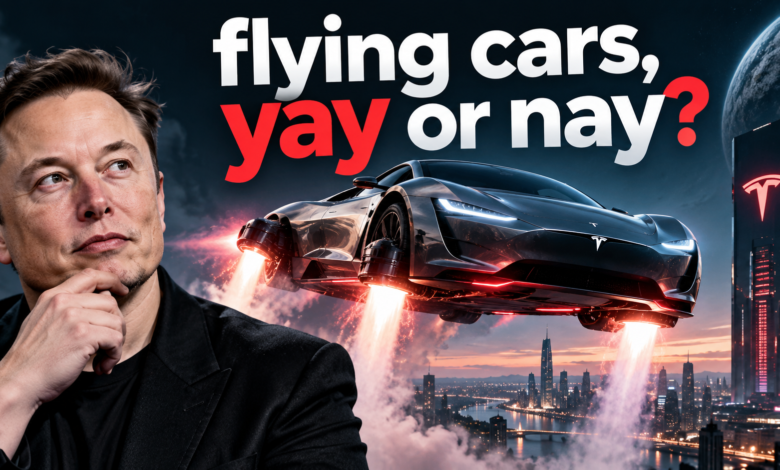
On October 15, 2026, Elon Musk did something that sounds like it belongs in a science fiction movie.
At a SpaceX facility in Texas, Tesla demonstrated its next-generation Roadster performing gravity-defying stunts, including driving upside down, launching into the air, flipping, and landing safely.
The internet went wild.
Tesla fans celebrated another technological breakthrough. Critics questioned whether the demonstration was anything more than an expensive publicity stunt.
And investors? They suddenly had something exciting to talk about.
But here’s the question nobody should ignore:
If Tesla can build a flying car, why can’t you actually buy one and legally drive it down your street?
More importantly, why is Elon Musk showing us this technology right now?
Because the answer might have more to do with Tesla’s stock price than the future of transportation.
So, What Exactly Is Tesla’s Flying Car?
First, let’s clear up a misconception.
Tesla hasn’t invented a vehicle that can casually fly across cities like something from The Jetsons.
What Musk revealed is a redesigned Tesla Roadster, an electric supercar developed with technology from his aerospace company, SpaceX.
Unlike traditional flying-car concepts that rely on wings or helicopter-style propellers, the Roadster’s most extreme version uses powerful cold-gas thrusters.
These thrusters release highly pressurised gas to generate force, allowing the vehicle to perform short airborne movements and dramatic manoeuvres.
Tesla has introduced three configurations: Performance, Thrust, and Rocket.
The Rocket version is the real headline-grabber. It features thrusters positioned around the vehicle, allowing it to lift off and control its movement in the air.
Tesla also demonstrated extraordinary acceleration, claiming the Roadster can reach 60 mph in less than one second.
That’s impressive engineering.
But there’s an important distinction between a car that can briefly launch itself into the air and a practical flying vehicle capable of everyday transportation.
Tesla has demonstrated the first. It hasn’t delivered the second.
The Pros: Why This Could Actually Be Revolutionary
Let’s give Tesla some credit.
Regardless of what you think about Elon Musk, the engineering behind this project is undeniably ambitious.
1. It pushes automotive engineering into new territory.
Combining electric vehicle technology with aerospace propulsion creates opportunities that conventional automakers haven’t seriously explored at this level.
The Roadster demonstrates what’s possible when two technologically advanced industries collaborate.
Even if the flying capability never becomes practical, the research could inspire advances in vehicle control, aerodynamics, propulsion, and safety systems.
2. It challenges traditional car manufacturers.
While established automakers compete over battery range, charging speeds, and entertainment screens, Tesla is experimenting with completely different vehicle capabilities.
That’s valuable from an innovation perspective.
Sometimes the most interesting technologies begin as impractical experiments.
3. It keeps the dream of futuristic transportation alive.
There’s something genuinely exciting about watching a car leave the ground.
The demonstration reminds people why they became interested in technology in the first place.
Not every engineering project needs immediate commercial value to inspire future breakthroughs.
And Tesla understands that excitement better than almost anyone.
The Cons: The Problems Nobody Can Ignore
Unfortunately, a spectacular demonstration doesn’t automatically translate into a usable consumer product.
And Tesla’s flying Roadster has some enormous obstacles.
Safety is the biggest concern.
Imagine sitting in traffic when the driver beside you decides to activate their car’s thrusters.
What happens to nearby pedestrians, cyclists, or other vehicles?
What if the propulsion system malfunctions mid-air?
What happens when a vehicle weighing thousands of pounds lands incorrectly in a crowded street?
Flying introduces risks that ordinary cars simply don’t have.
Then there’s the question of practicality.
Would you really need rocket-style thrusters for your daily commute?
The technology adds complexity, potential maintenance costs, and significant engineering challenges.
And let’s not forget the price. Tesla has advertised substantial reservation deposits for its higher-performance versions, while the final vehicle prices remain uncertain.
This isn’t technology designed for the average driver.
At least, not anytime soon.
My Prediction: You Won’t See Flying Teslas on Public Roads for Another 10 Years
Elon Musk says Roadster production is expected to begin in 2028.
But producing an electric sports car and legally allowing it to fly through public spaces are two completely different challenges.
Tesla’s own website explicitly states that the Rocket version is not approved for public road use.
And that creates a problem no amount of engineering talent can solve overnight.
Existing traffic regulations weren’t designed for cars that suddenly launch into the air.
Governments would need to address questions involving vehicle certification, aviation regulation, insurance, liability, driver qualifications, and where these vehicles could legally operate.
The United States already has aviation frameworks for emerging aircraft, but adapting those rules to a hybrid road-and-flight vehicle would be a complicated process.
Other countries would face their own approval requirements.
My prediction? We won’t see Tesla’s flying Roadster operating legally as an everyday road vehicle for at least another decade — possibly not before 2036.
That’s an opinion, not Tesla’s official timeline.
The conventional Roadster could arrive much earlier. But widespread legal use of the flying version is another story entirely.
And that assumes governments even want rocket-equipped vehicles sharing urban roads with regular traffic.
Technology doesn’t become practical simply because someone demonstrates that it works.
Society, infrastructure, and regulation have to catch up.
The Billion-Dollar Question: Why Did Musk Reveal This Now?
Here’s where things get interesting.
Tesla’s flying Roadster was unveiled just days before the company’s scheduled October 21 quarterly earnings announcement.
Coincidence?
Maybe.
But consider Tesla’s current position.
The company is investing heavily in artificial intelligence, robotaxis, and humanoid robots while facing pressure to justify its valuation and deliver stronger financial performance.
Investors increasingly want evidence that Tesla can become much more than an electric car manufacturer.
And what better way to reinforce that story than showing the world a car that can fly?
The message is powerful:
We’re not just building electric cars. We’re building technology that other companies can’t even imagine.
That’s exactly the type of narrative that can attract investors who buy into long-term technological potential.
Interestingly, Tesla shares reportedly jumped in premarket trading following the reveal, before subsequently falling during the regular trading session.
So the demonstration didn’t produce a sustained stock-market rally.
But the broader point remains.
Tesla doesn’t necessarily need to sell millions of flying cars for the announcement to serve a financial purpose.
It needs investors to believe the company remains an extraordinary technology business with enormous future potential.
This is where Musk excels.
He’s not just selling products.
He’s selling the future.
And sometimes, the future is worth more to investors than today’s actual products.
To be clear, there’s no proof that Musk organised the reveal specifically to manipulate Tesla’s share price.
The Roadster is a genuine engineering project, and Tesla has discussed its development for years.
But it’s reasonable to question whether the timing was chosen to maximise publicity and investor attention.
There’s also speculation about deeper cooperation between Tesla and SpaceX, making a public demonstration of their shared technology particularly convenient.
Whether intentional or not, the presentation reinforced exactly the kind of ambitious story Tesla wants Wall Street to hear.
We’ve Seen This Movie Before
Tesla first unveiled its second-generation Roadster back in 2017.
Production was originally expected in 2020.
It’s now 2026, and customers are still waiting.
This doesn’t mean the technology is fake.
It means Tesla has a history of announcing extraordinary products long before they’re commercially available.
And that’s why we should separate engineering demonstrations from actual product delivery.
A working prototype is an achievement.
A safe, affordable, legally approved product that customers can use every day is an entirely different achievement.
The gap between those two milestones can be enormous.
Final Thoughts: Is the Flying Tesla the Future, or a Brilliant Distraction?
I genuinely hope Tesla succeeds.
A future where cars can safely fly would be fascinating, and the Roadster demonstrates what ambitious engineers can achieve when given enough resources.
But I’m not convinced this announcement is really about getting flying cars into customers’ hands anytime soon.
It’s about excitement.
It’s about public attention.
And quite possibly, it’s about keeping investors convinced that Tesla remains years ahead of everyone else.
The Roadster might eventually become a revolutionary vehicle.
Or it might remain an expensive technological showcase that generates headlines without changing how ordinary people travel.
Either way, Musk has achieved something remarkable.
He’s made the world talk about Tesla’s future instead of focusing entirely on its present.
And perhaps that’s the most valuable thing this flying car has accomplished so far.
The real question isn’t whether Tesla can make a car fly.
It’s whether Tesla can turn that flying prototype into a real business before the hype runs out.
What do you think? Is Elon Musk genuinely pushing transportation into the future, or is this another masterclass in keeping investors excited?
Read more @ General Posting