AYUSH License Rules and Regulations: A Complete Guide for Manufacturers
The demand for Ayurvedic, Siddha, Unani and other traditional healthcare products has created opportunities for businesses in India’s AYUSH sector. Entrepreneurs and manufacturers are increasingly exploring the production of herbal medicines, Ayurvedic formulations, traditional healthcare products and other regulated preparations.
However, manufacturing and selling AYUSH medicines requires compliance with specific legal and quality standards. Businesses cannot simply manufacture and market products by describing them as Ayurvedic or herbal. They must identify the applicable regulatory category, obtain the required manufacturing licence and follow prescribed safety, quality and labelling requirements.
An AYUSH manufacturing licence is generally required for businesses manufacturing regulated AYUSH medicines for sale or distribution. This guide explains the major AYUSH licence rules and regulations, eligibility conditions, documentation, Good Manufacturing Practices (GMP), application procedure and compliance responsibilities for manufacturers in India.
What Is an AYUSH Manufacturing Licence?
An AYUSH manufacturing licence is a regulatory permission issued by the competent State or Union Territory Licensing Authority for manufacturing eligible AYUSH medicines for sale or distribution.
The term AYUSH covers the following systems:
- Ayurveda
- Yoga
- Naturopathy
- Unani
- Siddha
- Sowa-Rigpa
- Homoeopathy
However, the licensing requirements depend on the nature of the product. Manufacturing licences for Ayurvedic, Siddha and Unani medicines are governed by specific provisions of the Drugs and Cosmetics Act, 1940 and Drugs Rules, 1945. Homoeopathic medicines have separate regulatory requirements.
It is also important to understand that the Ministry of AYUSH does not directly issue manufacturing licences for AYUSH medicines. The relevant State or Union Territory Licensing Authority is responsible for granting and regulating these licences.
Major Laws Governing AYUSH Manufacturing in India
AYUSH medicine manufacturers must comply with the applicable provisions of the following legislation and regulatory requirements.
1. Drugs and Cosmetics Act, 1940
The Drugs and Cosmetics Act, 1940 provides the primary legal framework for regulating the manufacture, sale and distribution of drugs in India.
It establishes requirements relating to drug quality, licensing, inspection and action against violations. Specific provisions apply to Ayurvedic, Siddha and Unani medicines.
2. Drugs Rules, 1945
The Drugs Rules, 1945 prescribe detailed requirements for manufacturing licences, product standards, labelling, packaging and quality control.
Some important provisions include:
- Rules 151–169: Regulatory provisions concerning the manufacture and control of Ayurvedic, Siddha and Unani medicines.
- Rule 153: Application for a licence to manufacture Ayurvedic, Siddha or Unani drugs.
- Rule 157 and Schedule T: Good Manufacturing Practices for Ayurvedic, Siddha and Unani medicines.
- Rule 158B: Regulatory guidelines for issuing licences for Ayurvedic, Siddha and Unani medicines.
- Rules 161, 161A and 161B: Labelling and related requirements for Ayurvedic, Siddha and Unani medicines.
- Rules 85A–85I: Licensing requirements for manufacturing Homoeopathic medicines.
The exact provisions applicable to a manufacturer depend on the medicine category and proposed manufacturing activity.
3. Drugs and Magic Remedies (Objectionable Advertisements) Act, 1954
Manufacturers must also comply with restrictions on advertisements concerning certain drugs and treatments.
Businesses should avoid misleading medical claims, unsupported cure guarantees and prohibited promotional statements when marketing AYUSH medicines.
AYUSH Licence Rules and Regulations for Manufacturers
Manufacturers must satisfy several regulatory requirements before beginning commercial production.
1. Obtain a Valid Manufacturing Licence
Businesses manufacturing regulated AYUSH medicines for sale or distribution must obtain the applicable licence from the State or Union Territory Licensing Authority.
For Ayurvedic, Siddha and Unani medicines, Rule 153 provides for an application in Form 24D. The prescribed application process and applicable requirements should be checked with the relevant licensing authority.
Manufacturers using another licensed facility may need a loan licence or another applicable regulatory arrangement, depending on the business model.
2. Follow Good Manufacturing Practices (GMP)
Good Manufacturing Practices are essential for maintaining the safety, quality and consistency of AYUSH medicines.
For Ayurvedic, Siddha and Unani medicines, GMP requirements are prescribed under Schedule T of the Drugs Rules, 1945. Homoeopathic medicines are subject to the applicable GMP requirements under Schedule M-I.
GMP compliance generally covers:
- Suitable manufacturing premises and infrastructure.
- Proper storage of raw materials and finished products.
- Qualified technical personnel.
- Hygienic manufacturing conditions.
- Documented production procedures.
- Quality control and testing arrangements.
- Equipment maintenance and calibration.
- Proper packaging and labelling.
- Recordkeeping and product traceability.
Manufacturers should establish documented procedures to ensure that every batch meets the required quality standards.
3. Maintain Product Quality Standards
AYUSH medicines must comply with the applicable pharmacopoeial and formulation standards.
Manufacturers should ensure that raw materials are authentic, properly identified and of the required quality. They must also follow appropriate procedures for processing, manufacturing, testing and releasing finished products.
The applicable quality standards are prescribed through relevant pharmacopoeias and authoritative texts. Where required, manufacturers must maintain evidence relating to the safety and effectiveness of their formulations.
4. Employ Qualified Technical Personnel
Manufacturing and testing activities must be supervised by personnel who meet the prescribed educational and experience requirements.
The licensing authority may examine the qualifications and experience of technical staff responsible for manufacturing and quality control.
Businesses should maintain appointment records, qualification certificates and relevant experience documents.
5. Follow Labelling and Packaging Requirements
AYUSH medicine labels must comply with the applicable provisions of the Drugs Rules, 1945.
Depending on the product category, the label may need to mention:
- Name of the medicine.
- Ingredients and their quantities.
- Name and address of the manufacturer.
- Manufacturing licence details.
- Batch or lot number.
- Manufacturing date.
- Expiry date, wherever applicable.
- Dosage and directions for use.
- Required warnings and caution statements.
- Other prescribed particulars.
For Ayurvedic, Siddha and Unani medicines, Rules 161, 161A and 161B contain important labelling and expiry-related provisions.
Manufacturers should not use statements such as “100% safe”, “permanent cure” or “approved by the Ministry of AYUSH” without a lawful basis. A State manufacturing licence should not be represented as an approval issued by the Ministry of AYUSH.
Eligibility Criteria for Obtaining an AYUSH Manufacturing Licence
A business seeking an AYUSH manufacturing licence must fulfil the applicable legal and technical requirements.
Common requirements include:
- The applicant should be a legally recognised business or entity.
- The manufacturing premises should meet the prescribed infrastructure and hygiene standards.
- The proposed products should fall within the relevant AYUSH drug category.
- Qualified technical personnel should be available.
- The manufacturing facility should comply with applicable GMP requirements.
- Adequate quality control and testing arrangements should be maintained.
- The applicant should provide the required product and manufacturing information.
- The business should satisfy the applicable conditions imposed by the State Licensing Authority.
The exact eligibility criteria may vary according to the type of medicine, manufacturing arrangement and applicable state-level procedures.
Documents Required for AYUSH Manufacturing Licence
The applicant should prepare the required documents before submitting the application.
Commonly requested documents include:
- PAN card of the applicant or business.
- Certificate of incorporation or business registration.
- Identity and address proof of the applicant.
- Ownership proof or rent agreement for the manufacturing premises.
- Site plan and layout of the manufacturing facility.
- Details of manufacturing equipment and machinery.
- Details of technical staff and their qualification certificates.
- Details of the proposed products and formulations.
- List of raw materials and ingredients.
- Manufacturing process information.
- Quality control and testing arrangements.
- GMP compliance documents.
- Relevant declarations and application forms.
- Applicable fee payment details.
Additional documents may be required depending on the product category and the requirements of the concerned licensing authority.
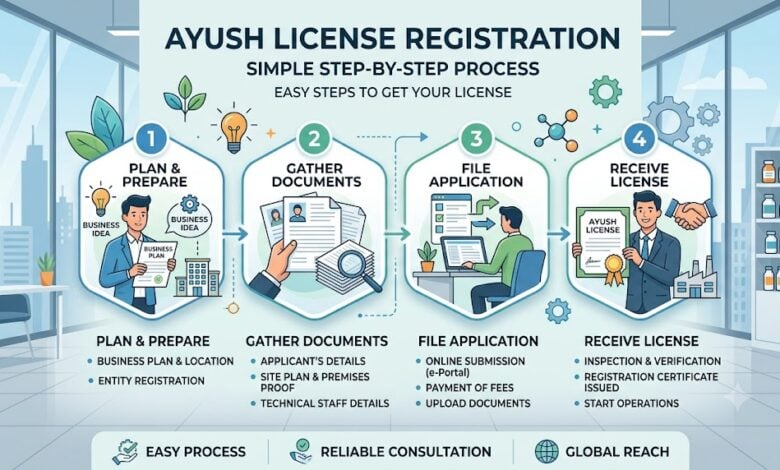
Step-by-Step Process to Obtain an AYUSH Manufacturing Licence
The application process generally involves the following stages.
Step 1: Identify the Product Category
Determine whether the proposed product is an Ayurvedic, Siddha, Unani, Homoeopathic or another category of product. The regulatory classification determines the applicable licence and compliance requirements.
Step 2: Establish the Manufacturing Facility
Arrange suitable premises, machinery, storage facilities and other infrastructure according to the applicable GMP requirements.
Step 3: Appoint Qualified Technical Personnel
Employ the required technical staff for manufacturing and quality control. Keep their educational and experience documents ready.
Step 4: Prepare the Application and Documents
Collect the required business, premises, technical and product-related documents. For ASU medicines, the application is generally made in Form 24D under Rule 153, subject to the applicable procedure.
Step 5: Submit the Application
Submit the application to the concerned State or Union Territory Licensing Authority through the prescribed portal or process. The e-AUSHADHI portal is used for specified ASU licensing applications.
Step 6: Regulatory Inspection
The authority may examine the premises, infrastructure, machinery, technical staff and GMP arrangements. It may also request clarification or additional documents.
Step 7: Grant of Licence
If the applicant satisfies the prescribed requirements, the licensing authority may grant the applicable manufacturing licence. Commercial manufacturing should begin only after obtaining the required permission and satisfying its conditions.
Compliance Requirements After Obtaining the Licence
Obtaining an AYUSH licence does not end the manufacturer’s regulatory responsibilities. Businesses must maintain compliance throughout their operations.
Important responsibilities include:
- Maintaining GMP standards at the manufacturing facility.
- Keeping batch manufacturing and quality control records.
- Purchasing authentic and quality-tested raw materials.
- Following approved manufacturing procedures.
- Conducting required quality checks.
- Maintaining proper storage conditions.
- Ensuring accurate product labels and packaging.
- Complying with applicable inspection requirements.
- Reporting and addressing quality-related issues where required.
- Renewing or updating licences as prescribed by the applicable rules.
Manufacturers should also ensure that any changes to premises, products, technical staff or manufacturing arrangements are handled in accordance with the licensing conditions.
Common Mistakes AYUSH Manufacturers Should Avoid
Businesses entering the AYUSH sector should be careful about the following mistakes:
- Starting commercial manufacturing without obtaining the required licence.
- Treating a herbal or traditional product as an AYUSH medicine without checking its legal classification.
- Ignoring GMP requirements.
- Employing technical personnel who do not meet prescribed qualifications.
- Using unverified or poor-quality raw materials.
- Making misleading medical or treatment claims.
- Printing incorrect manufacturing licence or product information on labels.
- Treating a State manufacturing licence as Ministry of AYUSH approval.
- Failing to maintain manufacturing and quality records.
Avoiding these mistakes can help businesses reduce compliance risks and maintain product quality.
Conclusion
AYUSH licence rules and regulations are designed to ensure that traditional medicines manufactured and marketed in India meet prescribed safety, quality and manufacturing standards. Businesses planning to manufacture Ayurvedic, Siddha, Unani or Homoeopathic medicines must understand the applicable provisions of the Drugs and Cosmetics Act, 1940 and Drugs Rules, 1945.
Obtaining the appropriate manufacturing licence, complying with GMP requirements, employing qualified technical personnel and maintaining accurate product records are essential responsibilities for manufacturers.
Before starting production, businesses should identify their product category and consult the relevant State Licensing Authority to confirm the applicable requirements. Professional regulatory assistance can help with documentation, application preparation, GMP-related compliance and coordination during the licensing process.
Frequently Asked Questions (FAQs)
1. Is an AYUSH licence mandatory for manufacturing Ayurvedic medicines?
Yes. Businesses manufacturing regulated Ayurvedic medicines for sale or distribution generally require the applicable manufacturing licence from the concerned State or Union Territory Licensing Authority.
2. Which law governs AYUSH manufacturing licences in India?
The primary framework is the Drugs and Cosmetics Act, 1940 and the Drugs Rules, 1945. Specific provisions apply to different categories of AYUSH medicines.
3. What is Schedule T in AYUSH manufacturing?
Schedule T prescribes Good Manufacturing Practices for Ayurvedic, Siddha and Unani medicines. It covers premises, equipment, personnel, hygiene, manufacturing procedures and quality control.
4. Who issues an AYUSH manufacturing licence?
The concerned State or Union Territory Licensing Authority issues the applicable manufacturing licence. The Ministry of AYUSH does not directly issue these manufacturing licences.
5. Can a business manufacture AYUSH medicines through a third-party manufacturer?
A business may explore a loan-licence or other permitted manufacturing arrangement, subject to the applicable rules and approval of the licensing authority.
6. What is Form 24D in AYUSH licensing?
Form 24D is the prescribed application form under Rule 153 for obtaining a licence to manufacture Ayurvedic, Siddha or Unani medicines for sale.
7. Is GMP certification mandatory for AYUSH manufacturers?
Manufacturers must comply with the applicable GMP requirements. Schedule T applies to Ayurvedic, Siddha and Unani medicines, while Schedule M-I contains the relevant requirements for Homoeopathic medicines.