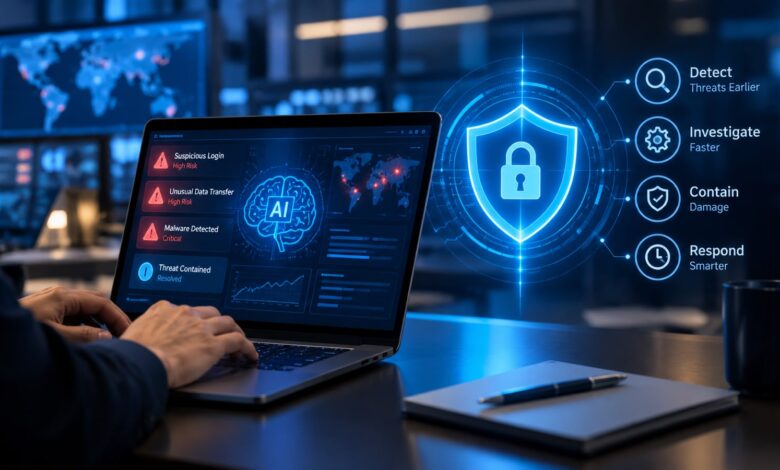
Cyberattacks are becoming more sophisticated, and organisations face increasing pressure to identify threats and respond before serious damage occurs. Traditional cybersecurity methods often depend on security teams reviewing alerts, investigating suspicious activity and deciding which actions to take. When hundreds or thousands of alerts arrive within a short period, identifying the most dangerous threats can become difficult.
Artificial intelligence (AI) could significantly improve this process. By analysing large volumes of security data, identifying unusual behaviour and supporting automated responses, AI can help organisations detect and contain cyberattacks more quickly. However, faster response times alone do not guarantee effective protection. Businesses must also consider accuracy, accountability, data protection and the legal consequences of automated security decisions.
Understanding how AI can improve incident response is therefore important for business leaders, cybersecurity professionals and legal advisers responsible for managing digital risks.
Why Speed Matters in Cyberattack Response
The time between the beginning of a cyberattack and its detection can influence the extent of the damage. An attacker who remains undetected may steal confidential information, move between connected systems, disrupt business operations or deploy ransomware across an organisation’s network.
Traditional security systems rely on predefined rules, known threat indicators and manual investigation. Although these methods remain valuable, they can struggle to identify unfamiliar attack techniques or connect seemingly unrelated warning signs. A suspicious login, an unusual file transfer and unexpected changes to account permissions may appear harmless individually but could indicate a coordinated attack.
AI can help connect these signals by analysing patterns across multiple systems. Earlier identification gives security teams more time to isolate affected devices, disable compromised accounts and prevent attackers from accessing additional resources.
For organisations handling sensitive customer information, financial records or commercially confidential documents, reducing the time required to detect and contain an incident can limit operational disruption and potential financial losses.
How AI Can Identify Cyber Threats Earlier
AI powered security tools can examine network traffic, user activity, endpoint behaviour and system logs to identify deviations from established patterns. Machine learning models can use historical data to recognise behaviour associated with malicious activity, even when the precise method has not previously been recorded.
For example, an employee account may suddenly access files outside its normal working pattern, download unusually large volumes of information and attempt to connect to unfamiliar external systems. A traditional security tool might generate separate alerts for each event. An AI system could correlate these activities and assign a higher risk score to the combined behaviour.
This approach can help security teams prioritise incidents according to their potential impact rather than treating every alert equally.
AI can also support threat intelligence analysis by comparing internal security events with information about emerging attack techniques, malicious infrastructure and known vulnerabilities. Such analysis may help organisations recognise early indicators of compromise before an attack develops into a wider incident.
Nevertheless, AI detection is not infallible. Legitimate business activity can resemble suspicious behaviour, while carefully designed attacks may avoid established detection patterns. Human review and regular testing remain essential to ensure security decisions are based on reliable evidence.
Automating Analysis and Containment
Detecting a possible attack is only the beginning of incident response. Security teams must determine what happened, which systems are affected and whether the activity represents a genuine threat. These investigations can consume valuable time, particularly when evidence is distributed across cloud platforms, business applications and employee devices.
AI can accelerate analysis by correlating alerts, summarising relevant log entries, identifying affected accounts and mapping potential connections between events. Generative AI tools can also help analysts understand unfamiliar technical information and prepare investigation summaries.
In some environments, AI can trigger predefined response actions. These may include temporarily disabling a compromised account, isolating an affected device from the network or blocking a known malicious connection. When carefully configured, automated containment can reduce the period during which an attacker has access to organisational systems.
However, the level of automation matters. Blocking a malicious connection may carry limited operational risk, whereas shutting down a critical business system could interrupt essential services. Organisations should establish clear thresholds for automatic action and require human approval for decisions with significant operational or legal consequences.
Effective incident response therefore combines rapid machine analysis with human judgement, tested procedures and clearly defined escalation arrangements.
The Role of Legal Advice in AI Driven Cybersecurity
Faster detection does not remove an organisation’s legal responsibilities following a cyber incident. Businesses must still assess whether personal data has been compromised, whether contractual obligations have been affected and whether regulatory notification requirements apply.
In India, the Digital Personal Data Protection Act, 2023, and applicable rules and commencement notifications are relevant to organisations processing digital personal data. The Information Technology Act, 2000, and sector specific requirements may also be relevant, depending on the incident and the organisation concerned. The applicable duties should be assessed against the law in force at the time of the incident.
Legal professionals can help organisations establish incident response policies, review contractual security obligations and determine when an incident requires notification to regulators, affected individuals or business partners. Working with cybersecurity legal counsel can also help ensure AI based monitoring practices have an appropriate legal basis and respect applicable privacy and confidentiality requirements.
Organisations should document how security decisions are made, which data AI tools process and who authorises significant response actions. These records may become important when demonstrating compliance, investigating a dispute or responding to questions from regulators.
Accountability, Privacy and Evidence
One of the central challenges of AI driven incident response is accountability. If an AI system incorrectly identifies an employee as a threat, automatically disables their access or deletes important files, the organisation must be able to explain why the action occurred and determine who was responsible for the decision.
Businesses cannot assume that responsibility transfers to a software provider simply because an automated system made the initial assessment. Accountability depends on the applicable legal framework, contractual arrangements and the circumstances of the incident.
Privacy presents another concern. AI systems may analyse employee communications, login records, browsing activity and other sensitive information. Organisations should consider whether this monitoring is necessary, proportionate and consistent with applicable data protection and employment requirements. Access controls, retention limits and appropriate safeguards can reduce the risk of excessive data collection.
Preserving evidence is equally important. Incident response teams should maintain reliable logs, record the actions taken by automated systems and protect forensic copies of relevant information. Investigators may need to establish how an attack occurred, which data was accessed and whether evidence has been altered.
Where an incident involves suspected criminal activity, cooperation with investigators and appropriate advice from criminal defence advocates may become relevant, particularly when individuals or organisations face allegations arising from digital activity. Evidence should be handled carefully so the investigation remains credible and procedural rights are respected.
Why Human Oversight Remains Essential
AI can process information at a scale and speed difficult for human analysts to match, but it does not possess independent legal judgement or a complete understanding of every business context. Its conclusions depend on the quality of available data, the design of the system and the assumptions used during training and deployment.
Poorly configured tools may produce excessive false alarms, overlook unusual attacks or take actions based on misleading information. Attackers may also attempt to manipulate AI systems by introducing deceptive inputs or exploiting weaknesses in automated workflows.
Organisations should regularly evaluate detection accuracy, test response procedures and review incidents where automated decisions caused disruption or failed to identify a threat. Security teams must understand when to trust an AI recommendation, when to investigate further and when to override the system.
Staff training is also important. Analysts need sufficient technical knowledge to challenge incorrect outputs rather than accepting recommendations without scrutiny. Clear responsibility for approving high impact actions helps prevent automation from becoming an unmanaged source of operational risk.
Building a Faster and More Reliable Response Strategy
The most effective approach is to introduce AI into an established cybersecurity framework rather than treating it as a replacement for existing controls. Organisations should begin by identifying gaps in their incident response process, such as slow alert investigation, inconsistent prioritisation or delays in isolating compromised devices.
They can then deploy suitable AI tools alongside established security monitoring, access management, backup systems and incident response plans. Testing should measure whether the technology reduces detection and containment times without increasing false positives or causing unacceptable disruption.
Businesses should also establish governance arrangements covering system access, data handling, audit records, human approval and vendor accountability. These measures are particularly important when AI tools can access sensitive information or take actions across connected business systems.
Regular exercises can help determine whether automated responses work as intended during ransomware incidents, account compromises and data breaches. Lessons from these exercises should inform improvements to both technical controls and legal response procedures.
Conclusion
AI could transform the speed of cyberattack response by identifying suspicious activity earlier, connecting security signals, accelerating investigations and automating carefully defined containment measures. These capabilities can help organisations reduce the time attackers spend inside their systems and limit the consequences of security incidents.
However, speed must be balanced with accuracy, privacy, accountability and legal compliance. Organisations that combine AI capabilities with human oversight, reliable evidence preservation and clear governance will be better positioned to respond effectively to evolving cyber threats.
As cyber risks continue to develop, the central question is not simply how quickly AI can react. It is whether organisations can use that speed responsibly, make defensible decisions and protect their systems without creating new legal or operational vulnerabilities.
Read more about artificial intelligence and cybersecurity in our other articles.