How GenAI is Redefining Insurance Policy Administration Systems
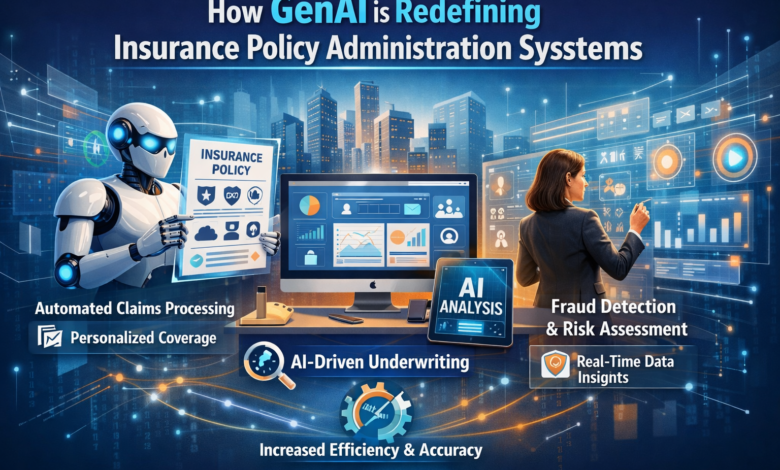
Modern insurance enterprises process millions of policies every year. Yet behind every policy distributed lies the involvement of manual workflows, document reviews, and compliance validations that consume time and resources. For insurance business leaders steering digital transformation, this reality offers both a challenge and an opportunity. Generative artificial intelligence is transforming the way insurers organize policy administration—not through automation alone, but through intelligent insurance policy administration software solutions that learn, adapt, and modernize every aspect of the policy lifecycle.
The technological capabilities offered by GenAI policy processing systems help insurers improve processing speed, precision, and regulatory adherence. Stakeholders in insurtech firms are increasingly recognizing its importance in positioning themselves competitively.
The Current State of Policy Administration: Acknowledging the Real Friction
Traditional insurance policy administration systems manage complex workflows that have not systematically evolved in decades. Policy administrators manually enter data, underwriters assess risk, compliance teams validate regulations, and service agents track policy distribution.
This approach leads to delays, compliance burdens, and resource constraints. These inefficiencies cost insurers significantly through delayed revenue, higher operational expenses, and customer churn. The issue is not the absence of technology, but the lack of intelligence in legacy systems.
Where Generative AI Steps In: A Practical Transformation
Generative AI introduces intelligent capabilities that directly address these inefficiencies and transform policy administration into a streamlined, data-driven function.
1. Intelligent Document Processing and Data Extraction
Policy applications arrive in multiple formats such as PDFs, emails, and handwritten forms. Traditional systems treat these as static inputs, limiting efficiency.
GenAI-enabled systems transform this process by interpreting documents contextually, extracting relevant data automatically, validating cross-document information, and ensuring data accuracy before human review. This reduces manual effort and allows teams to focus on higher-value decision-making.
2. Intelligent Risk Assessment and Underwriting Support
Underwriting decisions rely on analyzing patterns across claims, applicant data, and market trends. GenAI enhances this by identifying hidden correlations, integrating real-time market data, and enabling scenario-based evaluations.
As a result, underwriting becomes faster, more consistent, and more accurate. Rather than replacing human judgment, GenAI augments it, allowing underwriters to make more informed and strategic decisions.
3. Compliance and Regulatory Automation
Regulatory compliance is complex and constantly evolving. Traditional approaches rely heavily on manual tracking and updates.
GenAI simplifies this by mapping policies to regulations, generating audit trails, identifying impacted policies when regulations change, and automating documentation. This ensures compliance is proactive rather than reactive, especially for insurers operating across multiple jurisdictions.
Concrete Impact: Faster Policy Issuance
A typical policy issuance process today can take 7–13 days due to manual steps across data entry, underwriting, compliance, and documentation.
With GenAI-enabled systems, document processing becomes instantaneous, risk assessments are generated within hours, and compliance checks occur simultaneously. This reduces the overall timeline to just 1–3 days, improving revenue cycles, customer acquisition, productivity, and cost efficiency.
5. Smarter Risk Assessment: Confidence Through Intelligence
GenAI-driven systems analyze vast datasets in real time to detect anomalies, identify claim correlations, and benchmark against market conditions.
This leads to improved loss ratios, fewer unexpected claims, more competitive pricing strategies, and faster responses to market and regulatory changes.
Compliance Without Friction: Regulatory Confidence
GenAI transforms compliance into an integrated, continuous process. It enables automated regulatory tracking, policy impact analysis, template updates, and audit readiness.
For insurers, this translates into reduced compliance costs, faster audits, and stronger regulatory confidence while maintaining jurisdiction-specific standards.
I. Implementation Considerations: Making GenAI Work
Adopting GenAI requires careful planning. Insurers must integrate new capabilities with legacy systems using APIs, ensure data readiness and quality, and adopt a phased implementation approach.
Equally important is investing in data governance, bias assessment, and privacy protections to ensure reliable and compliant AI outcomes.
II. Evolving Workforce: Human + AI Collaboration
GenAI does not eliminate jobs but transforms them. Employees shift from repetitive administrative tasks to strategic roles. With proper reskilling and training, teams can effectively leverage AI tools, improving productivity and decision-making.
II. The Shift Ahead: A Competitive Imperative
The insurance industry is at a turning point. GenAI adoption is accelerating, reshaping customer expectations, operational efficiency, and competitive positioning.
Organizations that adopt early gain advantages in speed, cost, and talent acquisition, while those that delay risk falling behind in an increasingly digital-first market.
Conclusion: The Future of Policy Administration
The future of insurance policy administration is not about reducing human involvement but enhancing it. Intelligent systems handle routine complexity, enabling professionals to focus on strategic and high-value activities.
For insurance leaders, the question is no longer whether to adopt GenAI, but how to implement it effectively to drive sustainable growth and operational excellence.
Read More – https://generalposting.com/