Trump, Nvidia and China: The Billion-Dollar Power Play
An alleged espionage scandal, a presidential intervention, a potential US$15 million windfall and a growing technological divide. Nvidia's dramatic comeback raises uncomfortable questions about money, political power and the future of the global AI industry.
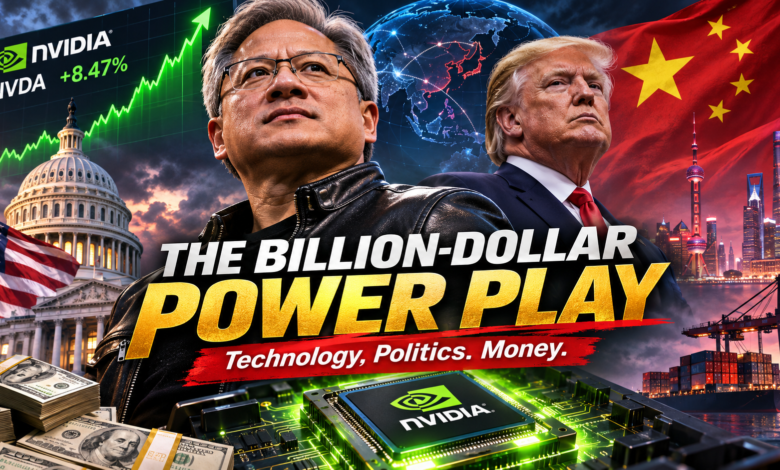
Trump Helped Bring Jensen Huang Back to Nvidia — and His Stock Holdings Gained Millions. Is Big Tech Breaking Up With China?
Imagine being the president of the United States, owning millions of dollars in a technology company’s shares, helping reinstate its CEO, and then watching its stock price skyrocket.
Welcome to the technology industry in 2026.
On 23 November, Jensen Huang officially returned as Nvidia’s CEO, just 11 days after resigning amid a scandal involving an alleged Chinese intelligence asset.
Donald Trump publicly celebrated his return.
Nvidia shares surged by more than 30%.
And Trump’s personal investments potentially increased in value by as much as US$15 million.
Coincidence, presidential intervention or simply the intersection of business and politics?
Meanwhile, Nvidia has stopped shipping certain advanced AI processors to China, raising an even bigger question.
Is the Western technology industry preparing for a future without China?
What Actually Happened to Jensen Huang?
On 12 November 2026, Jensen Huang resigned as Nvidia’s CEO following revelations about an extramarital relationship with a businesswoman suspected of having connections to Chinese intelligence.
Huang acknowledged serious mistakes in his personal life, while Nvidia launched an independent investigation.
Colette Kress, Nvidia’s chief financial officer, temporarily took over as CEO.
The situation was particularly sensitive because Nvidia isn’t just another technology company.
Its processors power artificial intelligence, scientific research, autonomous systems and potentially sensitive military applications.
Access to advanced AI chips has become a national security issue.
But just when it appeared Nvidia was preparing for life without its founder, the story took an extraordinary turn.
Jensen Huang was coming back.
And the president of the United States had personally become involved.
Did Donald Trump Pull Some Strings?
This isn’t entirely speculation.
In an interview with CNBC on 23 November, Trump openly acknowledged his involvement in persuading Nvidia’s board to reinstate Huang.
“I made the deal,” Trump said.
He also took to Truth Social to celebrate Huang’s return, describing the Nvidia founder as a national treasure and arguing that his leadership was important to the American economy.
Nvidia’s official announcement confirmed that senior US government officials had provided input before the board unanimously approved Huang’s reinstatement.
The company said it was confident his return presented no national security risk.
Trump also stated that the US government had no evidence Huang had engaged in unlawful conduct.
Nevertheless, Nvidia’s independent investigation remains ongoing.
There’s a legitimate economic argument for bringing Huang back. He built Nvidia into one of the world’s most influential technology companies, and his departure contributed to considerable uncertainty across financial markets.
But there’s another detail that deserves attention.
Trump himself owns Nvidia shares.
Trump Potentially Made US$15 Million From Huang’s Comeback
According to CBS News and analysis reported by the Financial Times and The Guardian, Trump’s Nvidia investments potentially increased in value by between US$1.3 million and US$15 million following Huang’s reinstatement.
Financial disclosures indicate that Trump held between US$13 million and US$58 million in Nvidia shares at the end of 2025.
Reuters also reported on 19 November that Trump had purchased up to US$265,000 worth of Nvidia shares during September.
Consider the sequence of events.
- Nvidia’s CEO resigns, and the company’s share price falls.
- Trump publicly supports Huang’s return.
- Trump personally speaks with Nvidia’s board.
- Huang is reinstated as CEO.
- Nvidia shares surge by more than 30%.
- Trump’s investments potentially gain millions in value.
It’s a sequence that raises obvious questions about potential conflicts of interest.
To be clear, there is no confirmed evidence that Trump intervened specifically for personal financial gain or engaged in insider trading.
The White House maintains that his investment portfolio is independently managed by third-party financial institutions. The estimated gains are also increases in investment value, not necessarily profits from selling shares.
Trump has said his intervention was driven primarily by concern for Nvidia’s long-term importance to America.
But the episode raises a broader corporate governance question: how should presidential financial interests be managed when government decisions can dramatically influence the value of individual companies?
Nvidia Has Stopped Shipping Advanced AI Chips to China
While everyone was distracted by Huang’s personal life and Trump’s intervention, Nvidia made another significant announcement.
It stopped shipping licensed Hopper-generation data centre products to China, including its powerful H200 AI processors.
These products generated US$2.4 billion in sales to China during Nvidia’s most recent quarter.
Interestingly, Washington had previously relaxed restrictions to allow certain Chinese customers to purchase these processors, following lobbying from Huang.
Beijing, however, has also restricted imports as it seeks to reduce its dependence on American technology.
This isn’t simply America cutting China off.
Both countries are reconsidering their technological dependence on each other.
For now, Nvidia appears financially capable of absorbing the disruption. Its latest quarterly revenue reached US$115.8 billion, more than double the corresponding period a year earlier.
But losing access to Chinese AI developers could have consequences that extend far beyond quarterly sales.
Are All Tech Companies Trying to Get Rid of China?
Nvidia isn’t alone.
Apple has been expanding manufacturing operations in India.
Microsoft has offered relocation opportunities to some China-based AI and cloud computing employees.
Semiconductor companies are diversifying their supply chains, while technology businesses are increasingly scrutinising access to sensitive intellectual property.
For decades, China offered the technology industry enormous manufacturing capacity, competitive production costs, skilled engineers and millions of potential customers.
Today, those advantages are being weighed against geopolitical tensions, regulatory uncertainty and national security concerns.
The industry calls this de-risking.
It doesn’t necessarily mean abandoning China altogether. It means reducing dependence on the country so that a political dispute or regulatory change cannot suddenly cripple an entire business.
Apple still has significant interests in China. Nvidia has actively sought access to Chinese customers.
There is no universal corporate strategy to abandon China.
But the relationship is clearly becoming more complicated.
Is Chinese Talent Becoming a Target Too?
This is where things become particularly sensitive.
Technology companies have legitimate reasons to protect intellectual property and prevent unauthorised access to sensitive systems.
But protecting technology and discriminating against employees based on their nationality or ethnicity are entirely different things.
There is no evidence of an industry-wide campaign to remove Chinese employees from Western technology companies.
Such an approach would also overlook China’s enormous contribution to artificial intelligence.
According to MacroPolo’s Global AI Talent Tracker, approximately 47% of the top-tier AI researchers in its 2022 dataset completed their undergraduate education in China.
The American technology industry has benefited enormously from international talent.
Jensen Huang himself was born in Taiwan before immigrating to the United States.
The challenge for technology companies is establishing effective security controls based on actual risks and individual conduct, rather than treating someone’s cultural background as evidence of disloyalty.
What If Cutting China Off Actually Makes China Stronger?
Here’s the potential irony.
The purpose of restricting China’s access to advanced American chips is largely to protect sensitive technology and preserve national security.
But those restrictions also create a powerful incentive for China to develop alternatives.
Huawei is developing its own Ascend AI processors.
DeepSeek has demonstrated China’s ability to compete in advanced AI model development.
Chinese businesses are investing heavily in domestic semiconductor technology, software and computing infrastructure.
Replacing Nvidia won’t be easy.
Its competitive advantage isn’t just its hardware. It’s CUDA, its software libraries, developer tools and an ecosystem that has taken years to build.
But if Chinese businesses cannot reliably purchase Nvidia’s products, developing alternatives becomes a commercial necessity.
And once those businesses have invested billions in their own technology, why would they automatically return to American suppliers?
Nvidia could lose more than a customer.
It could gain an entirely new generation of competitors.
Are We Heading Towards Two Separate Technology Worlds?
Imagine a future where the global technology industry operates across two increasingly incompatible ecosystems.
One dominated by American processors, software platforms and AI models.
Another built around Chinese chips, infrastructure and domestic AI technologies.
Businesses operating internationally could face higher costs, duplicated development work and increasingly complicated regulations.
Countries like Australia could find themselves navigating competing technology standards and geopolitical pressures.
For consumers, the consequences could include higher prices and fewer choices.
The global technology industry was built through international collaboration.
Fragmenting that ecosystem could fundamentally change how innovation happens.
Final Thoughts: Technology, Politics or Money?
Jensen Huang’s dramatic return demonstrates how closely the technology industry, financial markets and government policy have become interconnected.
A corporate leadership decision can move global markets.
A presidential intervention can influence a company’s future.
And government officials with financial interests in technology companies can benefit from the same market movements their decisions help create.
Whether Trump’s intervention was motivated exclusively by national economic interests remains a question that the available financial disclosures cannot fully resolve.
Meanwhile, the growing technological divide between America and China presents an equally significant long-term challenge.
Reducing dependence on China may make Western companies more resilient. But it could also accelerate the development of competing Chinese technologies.
Perhaps the biggest threat to Nvidia isn’t losing China as a customer.
It’s China eventually discovering that it no longer needs Nvidia.
And perhaps the biggest question surrounding Huang’s comeback isn’t simply why Trump wanted him back.
It’s how we distinguish public economic interests from private financial interests when the two are so closely connected.
What do you think? Was Trump’s intervention necessary to protect America’s AI industry, or does his financial stake raise legitimate concerns? And could distancing Big Tech from China ultimately create its biggest competitor?
Read More @ General Posting