
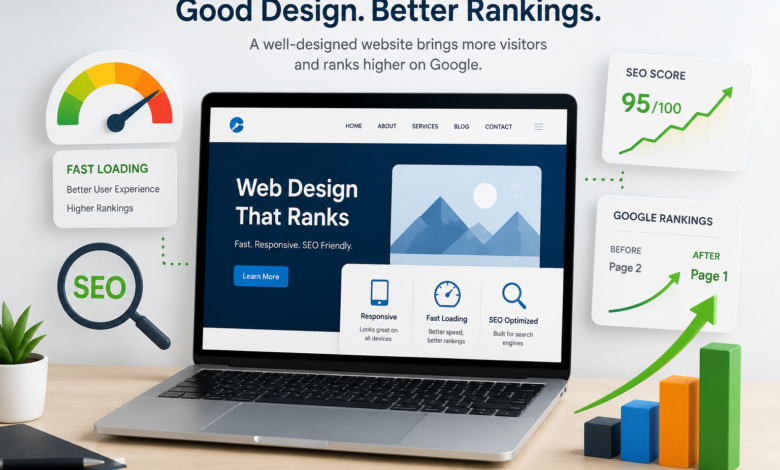
Let’s get one thing straight: a striking website nobody can find is basically a billboard in the middle of the desert. You can pour months into slick visuals, but if Google won’t rank you, who’s going to see it?
Most people take it wrong, they treat web design and SEO like two separate jobs. They’re not. The stuff that makes your site lovely for real humans is the exact same stuff that makes Google fall for it. Get the design right, and your rankings usually tag along.
Design and SEO are Best Friends
For years it’s been a tug-of-war. The design teams want everything clean and simple, while the SEO teams want more content and structure so Google has something to chew on. But it isn’t really a fight.
Google uses over 200 factors to rank a page, and most boil down to one question: is this site good for the person using it? Make humans feel valued, and you’ve won half the SEO battle already.
Why This Even Matters (The Numbers Don’t Lie)
Still think rankings are a “nice to have”? Look at the click-through math. The top result grabs over a quarter of all clicks. The second gets about 15%. By the 10th spot, you’re scraping just 2.5% — anything past page one is a ghost town.
And here’s a stat that’ll make you sit up: every $1 spent on user experience brings back around $100. That’s a 9,900% return. Design is one of the smartest investments you’ll make.
The Technical Detail Google’s Bots Care About
Your visitors won’t notice it directly, but search engines live for it:
- Speed: Nearly 70% of people say a slow site makes them less likely to buy. Trim huge image files, clean up the code, and ditch the plugin overload, and your pages fly.
- Mobile-friendliness: There are over 6.4 billion mobile internet users, and we spend more than half our online time on phones. Google’s rewarded responsive sites since its 2015 mobile update are non-negotiable.
- Crawlable code and sitemaps: Stick to clean HTML for your main content — too much JavaScript chokes Google’s crawlers. A sitemap hands Google a map so it finds every page.
- URLs and metadata: Keep URL slugs short and keyword-focused. And don’t sleep on title tags — 36% of SEO pros call them the most important element. Titles cap at 60 characters, meta descriptions at 160.
- The small stuff: Smart image file names, proper alt tags, and a secure HTTPS connection all whisper “trust me” to Google.
The Human Bits Your Visitors Actually Feel
Now the part real people experience — and since Google watches how they behave, it counts just as much:
- Readability: Big, clean fonts, short paragraphs, and plenty of white space. If your copy’s a wall of tiny text, people bounce – and Google notices it.
- Easy navigation: Good design means no one has to think about where to click. Smooth menus and smart internal links keep folks exploring.
- Trust at a glance: A clean, modern look builds instant credibility. The longer people stay (your dwell time), the more it tells Google your page is worth showing off.
- Accessibility: Alt tags and a logical heading order help screen-reader users and give Google clearer clues about your content — one move, two wins.
See the pattern? Every human win up there doubles as an SEO win — that’s the whole point.
It All Loops Back to One Simple Thing
Google leans on its E-E-A-T idea — experience, expertise, authoritativeness, and trust. It wants to rank sites that genuinely help people.
So when your design keeps bounce rates low and visitors happy, you’re meeting Google’s criteria without even trying. That’s why solid web design services in California or anywhere else pay off twice: better for humans, better with search engines, and the same effort.
Last Words
Web design and SEO aren’t two separate to-do lists. They’re partners chasing the same goal: happy visitors and higher rankings. Nail both and your site stops just sitting there and starts bringing in business.
That’s the sweet spot AccessiWise lives in. We’re a digital and IT company blending accessibility, web design, development, and growth-focused SEO into one tidy package. From WCAG-aligned, user-first designs to data-driven SEO that pulls in real, qualified traffic, we help protect your business and unlock its full online potential. Let’s build something that ranks and welcomes everyone.
FAQs
- Does web design really affect SEO rankings?
Ans: Yep, big time. Speed, mobile performance, navigation, and readability are all shaped by design, and Google weighs every one. A clean, fast site beats a clunky one even with similar content. - Why does my site look great but still rank poorly?
Ans: Pretty doesn’t equal findable. It might be slow, weak on mobile, badly structured, or thin on useful content. Sort out speed, navigation, and mobile-first — then polish the visuals. - Is page speed about design or SEO?
Ans: Honestly, both. Oversized images, messy code, and too many plugins are design choices that tank your load time, and slow pages frustrate users and drag rankings down too. - How much does mobile design matter for SEO?
Ans: Loads. Google uses mobile-first indexing, so it judges your phone version first. With most browsing on mobile, a responsive layout is the bare minimum. - Does accessibility help SEO?
Ans: It does. Alt text, semantic HTML, and clear headings help screen readers and search bots alike. Accessible sites also keep people engaged longer, which nudges rankings up. - Can good design alone get me to page one?
Ans: Not on its own. Design builds the foundation, but you still need quality content, smart keywords, and proper seo services in California or your local area to climb.


