
Why Every Business That Ignores Mobile App Development in 2026 Is Handing Market Share to Competitors
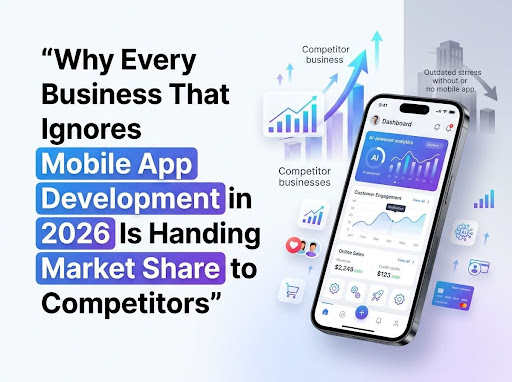
The numbers are clear. In 2026, customers no longer just prefer mobile, they live on it. They shop, bank, book, learn, and consume everything through apps. Businesses that still treat mobile app development as optional are not just falling behind. They are actively handing market share to competitors who understood this shift early.
Here is why mobile apps are now non-negotiable in 2026 and what businesses risk by ignoring them.
The Mobile-First Business Era Has Already Arrived
The shift to mobile is no longer a trend. It is the new default. Customers spend more time inside apps than on browsers, social platforms, or any other digital channel.
A website might bring you traffic. An app builds you a relationship. In 2026, mobile apps are the center of customer engagement, sales, retention, and brand loyalty. Businesses without apps are losing visibility, trust, and revenue, often without realizing it.
Why Mobile Apps Are No Longer Optional for Businesses
The reasons are direct and undeniable:
- Consumers now spend the majority of their digital time inside apps
- Mobile apps give businesses direct access to customers without algorithms in the way
- Apps enable faster, more personalized customer experiences
- They build convenience, trust, and habit
- Modern businesses compete through ecosystems, not just products
A mobile-first business strategy is no longer a competitive advantage. It is the cost of staying in the game.
Businesses Without Apps Are Losing Customers to Competitors
While some businesses are still debating whether to invest in an app, their competitors are already converting their customers.
In 2026:
- Competitors use apps to build loyalty and lock-in
- Push notifications drive repeat engagement at zero acquisition cost
- One-tap transactions increase conversions massively
- Mobile convenience directly influences buying decisions
- Customers actively prefer brands with seamless app experiences
Every day a business operates without an app is a day customers get a reason to switch.
Mobile Apps Are Becoming the Most Powerful Customer Engagement Tool
Mobile apps are no longer just digital storefronts. They are full customer engagement engines.
Modern business apps now deliver:
- Personalized experiences powered by AI and analytics
- Real-time communication and notifications
- Loyalty programs and gamification
- In-app support and conversational AI
- Lifecycle management across the entire customer journey
This is what turns a one-time buyer into a daily user. No other channel can do this at the same depth.
AI-Powered Mobile Apps Are Changing Business Competition
The real shift in 2026 is that mobile apps are now AI-powered by default. AI is making apps smarter, faster, and more profitable.
Modern AI mobile apps deliver:
- Chatbots handling support and sales 24/7
- Predictive recommendations boosting conversions
- Smart automation cutting operational costs
- Real-time analytics revealing customer behavior
- Intelligent personalization at scale
Businesses still running static websites or basic apps cannot compete with this level of intelligence. AI-powered apps are simply outperforming everything else.
How Mobile Apps Increase Revenue and Customer Retention
The ROI of mobile apps in 2026 is no longer debatable. Apps drive measurable revenue through:
- Faster checkout and one-tap payments
- Subscription and membership models
- Personalized promotions and upselling
- AI-driven retention campaigns
- Push notifications that bring users back
Every dollar invested in a well-built mobile app compounds, because retention compounds. That is the math behind mobile-first growth.
Industries Already Dominating Through Mobile Apps
The leaders in every major industry are already mobile-first:
- Retail and e-commerce with personalized shopping and dynamic pricing
- Healthcare and telemedicine with AI-powered consultations and monitoring
- Food delivery and logistics with predictive ordering and smart routing
- Real estate with AI property matching and virtual tours
- Travel and hospitality with personalized itineraries and bookings
- Education and FinTech with adaptive learning and intelligent financial services
In every one of these categories, the businesses leading the market in 2026 are app-first, not website-first.
Mobile Apps Give Small Businesses the Power to Compete With Big Brands
This is the biggest opportunity in 2026. App development is no longer reserved for big budgets.
Affordable AI tools and cloud platforms now let small businesses:
- Launch high-quality apps at a fraction of past costs
- Automate operations using AI
- Run hyperlocal marketing through mobile ecosystems
- Build personalized engagement that big brands often cannot match
- Scale faster through mobile-first strategies
A small business with a smart app can now outperform a large brand stuck on a generic website. That is the new reality.
Why Websites Alone Are No Longer Enough in 2026
Websites still matter, but they are no longer the primary growth channel. In 2026, websites alone fall short because they:
- Generate slower engagement compared to apps
- Offer limited personalization capabilities
- Depend heavily on third-party traffic sources like Google or ads
- Have significantly lower retention rates
- Cannot build the same brand ecosystem a mobile app can
A website brings customers in. A mobile app keeps them. Smart businesses now invest in both, but the app is the priority.
Data and Analytics: The Hidden Competitive Advantage of Mobile Apps
The most underrated advantage of mobile apps is data. Apps give businesses first-party, real-time insight into customer behavior that no website or third-party platform can match.
This data powers:
- Real-time tracking of user behavior
- Predictive analytics for better decisions
- Personalized recommendations through AI
- Customer journey optimization
- Smarter marketing and operations
In a post-cookie world, first-party data is the new currency. Mobile apps are how businesses mine it.
The Rise of Super Apps and Integrated Digital Ecosystems
Businesses are no longer building single-purpose apps. The shift in 2026 is toward super apps and integrated ecosystems.
These platforms combine:
- Payments and digital wallets
- Loyalty and rewards
- Support and conversational AI
- Commerce and bookings
- AI-driven personalization across every layer
For businesses, this creates ecosystem lock-in. Customers stay because the app does everything they need. That is the new competitive moat.
Common Reasons Businesses Avoid App Development And Why They’re Wrong
The most common objections are easy to break down:
- “Apps are too expensive.” Not anymore. Cloud-based development, pre-built modules, and AI tools have made apps far more affordable.
- “Our website is enough.” It is not. Websites convert. Apps retain.
- “Only big brands need apps.” Wrong. Small businesses are gaining the most from apps in 2026.
- “Maintenance is too difficult.” Modern DevOps and MLOps have made app maintenance significantly easier.
The real cost is not building an app. It is not building one while your competitors do.
Future Trends: What Mobile Apps Will Look Like Beyond 2026
The next wave is already here:
- AI-first mobile experiences as the new default
- Voice-enabled apps for hands-free interaction
- AR and VR commerce inside apps
- Predictive and autonomous customer journeys
- Hyper-personalized digital ecosystems
By 2027, the gap between businesses with intelligent apps and those without will be impossible to close.
Why Businesses Must Invest in Mobile App Development Now
The opportunity window is still open, but it is closing fast. Early adopters are already locking in market share. Customer expectations are rising every quarter. Mobile apps are no longer just a digital tool, they are core business infrastructure.
Investing in mobile app development today means:
- Capturing market share before competitors do
- Meeting rising customer expectations head-on
- Building scalable, future-ready business infrastructure
- Creating direct customer relationships you fully own
- A clear competitive edge in your industry
Businesses without mobile apps in 2026 are not playing it safe. They are quietly disappearing from the customer’s daily life.
Build the Future With Junkies Coder
At Junkies Coder, we help businesses build mobile apps that are not just functional, but intelligent, scalable, and built for the next decade of growth. Whether you are a startup launching your first app or an established brand modernizing your digital presence, we build AI-powered mobile apps designed to win in 2026 and beyond.
We do not build clones. We build category leaders. From strategy to MVP to scale, we partner with founders and businesses to turn ideas into mobile-first ventures that capture real market share.
Partner with Junkies Coder to launch your mobile app and stop handing your market share to competitors who moved faster than you.
FAQ
Why do businesses need mobile apps in 2026? Because customers spend most of their digital time inside apps, and businesses without apps are losing engagement, loyalty, and revenue.
Are mobile apps better than websites for businesses? For engagement, retention, and personalization, yes. Most modern businesses now run both, but apps drive long-term customer value.
How do mobile apps improve customer retention? Through push notifications, loyalty programs, personalized content, and seamless in-app experiences that build daily habits.
What industries benefit most from mobile apps? Retail, healthcare, food delivery, real estate, travel, education, and FinTech are seeing the biggest gains.
How much does mobile app development cost? It varies based on features, AI integrations, and scale, but modern tools and platforms have made it more affordable than ever.
Can small businesses afford mobile apps? Yes. Affordable cloud-based development and AI tools have made mobile apps accessible to SMBs and local businesses.
How do AI-powered apps improve business growth? By automating operations, personalizing customer journeys, predicting behavior, and driving higher conversions and retention.
What is the future of mobile app development? AI-first experiences, voice-enabled apps, AR and VR commerce, super apps, and fully autonomous customer journeys.


