
The Role of a Strong Drivetrain in Motor Grader Efficiency & Control
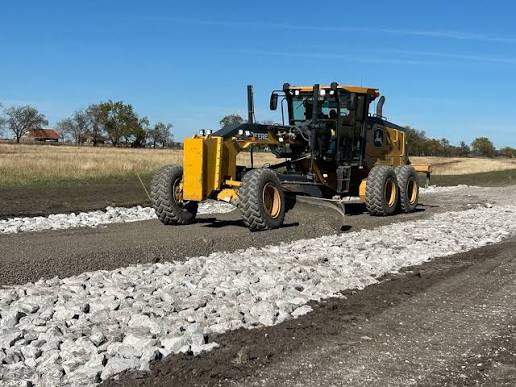
The importance of a robust drivetrain in the efficiency and control of a motor grader. Any experienced grader operator will tell you that the drivetrain makes the difference between a machine that simply gets the job done and one that makes the work look easy. Not horsepower alone. Not blade size. It’s the drivetrain, the entire system of parts that transfer power from the engine to the wheels, that can either help or hinder a motor grader in the dirt.
What the Drivetrain Actually Does
The drivetrain of a motor grader is essentially a way of transferring energy from the diesel engine to the wheels in a controlled and usable manner. It seems easy until you need to maintain a consistent grade on a loose gravel road, push material up a slope, or make consistent passes in wet soil without spinning out. The drivetrain consists of the transmission, torque converter, tandem rear drives, differentials, axles, and, in many modern machines, hydraulic front-wheel drive systems. These all must function together harmoniously. If they do, the blade will perform as expected. If they do not, the quality of the grade is compromised, and so is the operator’s confidence.
Unlike dozers or loaders, graders require a particular type of power, steady, controllable, and smooth. A dozer can muscle through a cut. A grader has to finesse its way through one. This is where the drivetrain design is more important in this machine class.
How Drivetrain Strength Directly Affects Traction and Blade Control
Understanding how the strength of the drivetrain directly impacts traction and blade control. Understanding how the strength of the drivetrain directly affects the traction and blade control. A weak or poorly engineered drivetrain causes wheel slip, unequal power distribution, and blade instability, which all contribute to loss of grading quality. A good drivetrain maintains torque at the wheels, and the blade remains steady. The relationship between traction and blade performance is a direct and punitive one.
Here’s what a powerful drivetrain can do on the job:
- Even torque distribution means no wheel spin on loose or wet surfaces, which provides a stable base for the blade to operate on.
- Drivetrain lag is minimized, allowing the machine to react to the operator’s speed and direction changes as soon as they are made, particularly important in finish grading where precision is paramount.
- Smooth low-speed control gives operators the freedom to creep along at the right speed for fine work without constantly working the transmission or inching the pedal.
- Improved push ability on heavy cuts, without the engine being dragged or traction lost at the rear tandems.
- Better hill climbing stability, which means that the machine will not hunt or surge on hills when riding.
That’s why contractors frequently consider the powertrain specs as much as blade pull ratings or operating weight when they are considering CAT graders for sale.
Hydrostatic vs. Powershift: A Real-World Difference
For decades, the debate over hydrostatic and powershift transmissions has been influencing motor grader design. Powershift transmissions, the most common type in mid-to-large graders, shift under load through the use of planetary gearsets and hydraulic clutches, making them ideal for heavy production grading, where sustained power is the goal. In particular, direct-drive powershift systems lock up the torque converter in most gears, which helps to increase overall efficiency and minimize torque losses.
In compact and mid-size graders, hydrostatic transmissions rely on hydraulic pumps and motors to move power without any gear shifting whatsoever. The outcome is infinite variable speed control: smooth, precise, and easy to modulate. Hydrostatic systems offer an operator a level of feel that powershift systems can’t match, for fine grading, detail work, and operations in hilly terrain.
Both systems are never declared the winner outright. Road construction firms that do a lot of work favor powershift durability and efficiency over prolonged loads. Hydrostatic control is a worthwhile trade-off for municipal and finish-grade operators.
All-Wheel Drive and Tandem Systems: When Traction Changes Everything
AWD systems are not standard equipment on all motor graders, and that’s by design. The majority of grading passes are done on the back drive. However, in slippery, soft, or steep conditions, front-wheel assist alters the performance equation quite a bit.
AWD can provide the following advantages in extreme weather:
- Significant increase in grip on soft ground, gravel, snow, and loose surfaces on which rear drive alone will cause wheel spin.
- More stable side slopes, as all six wheels provide power, and the machine tracks consistently.
- More aggressive material movement without losing forward momentum, which is important on mining haul roads and rural grading projects.
- Less degradation of the track surface on completed surfaces because the machine is not clawing for traction.
John Deere motor graders are available in both AWD and 6WD models, and come with torque management systems such as Auto-Shift and Auto-Shift PLUS that automatically adjust power distribution as conditions change. This helps to lighten the operator’s workload significantly during long grading shifts.
Electronic Controls and Smart Drivetrain Management
Modern grader drivetrains are not just mechanical systems operated by the operator’s feet and hands. Electronic powertrain management now automatically controls transmission shift, differential lock, traction control, and even blade articulation. On John Deere motor graders equipped with Grade Pro technology, operators no longer need to control the inching pedal. Because the throttle and brake pedals now handle that function, completely changing how graders operate.
Likewise, CAT graders for sale will discover the Stable Blade system that automatically senses machine bounce and slows down to counterbalance, then speeds up to set speed. This type of intelligence directly improves grade surface quality, reduces operator fatigue during long shifts, and integrates seamlessly into the drivetrain.
Drivetrain Durability and Maintenance
The drivetrain is one of the most costly systems to repair on any motor grader. A transmission failure, axle rebuild, or transmission overhaul can keep a machine out of service for days and can cost a lot of parts and labor. This is why drivetrain durability is an important consideration for fleet economics.
Stronger drivetrains perform better in the areas where they are most likely to wear:
- Frequent shuttling: Often changing directions, stressing transmission clutch packs and seals.
- High-pressure grading: Constant loading of tandem drives and axle parts by high blade-down pressure grading.
- Extreme temperature management: Running in harsh environments where the viscosity of hydraulic fluid and heat management are important to transmission life.
- Extended high-load grading: In heavy road construction or mining operations, crews often push duty cycles to their limits.
Caterpillar and John Deere equip their current motor grader platforms with sealed tandem drives, pressurized and filtered differential systems, and self-adjusting wet-disc brakes to extend service life and reduce unplanned downtime.
FAQs
1. Does drivetrain type affect grading quality?
A: Yes, significantly. The type of transmission will influence the smoothness of power delivery to the wheels. Thus, the quality of the surface finish and blade stability.
2. Is AWD worth the extra cost on a motor grader?
A: This is dependent on the application. The rear drive is adequate for normal road maintenance on firm ground. AWD is a significant productivity benefit in soft soil, slopes, and snow removal.
3. Are electronic drivetrain systems harder to maintain?
A: Modern electronic systems provide diagnostic capability that can make troubleshooting easier. They do need software and sensor system experts, though, which is a factor for remote fleet operations.
4. How does drivetrain strength affect fuel consumption?
A: A good drivetrain minimises power loss between the engine and the wheels. Efficient transmissions and torque management mean the engine has to work less to achieve the same output. This directly translates to lower fuel burn per hour.


